Taking on SDVs Head-On: An IT Company’s Challenge Showcased at the Mobility Show Interview with a key figure at SCSK, which exhibited a concept car
- # Collaborative Partnership
- # Mobility DX
SCSK Executive Officer
Deputy Head, Mobility Business Group / Head, SDM Business Development Center
Akihiro Mitani

Before joining SCSK, Mitani worked at an OEM (automaker), involved in development areas such as powertrains and integrated control systems. What he took away from that experience was a strong sense of crisis: if Japan’s automotive industry continues on its current path, it will face extremely difficult conditions as it competes globally.Automotive competitiveness can be distilled into five functional domains: (1) driving safety—running, turning, and stopping; (2) fuel economy; (3) electrified powertrains; (4) automated driving; and (5) digital functions such as the connected/intelligent cockpit. For Japanese OEMs, competitive differentiation is shrinking not only in their traditional strength—driving safety—but also in fuel economy, as players in Europe, the U.S., China, and elsewhere have intensified efforts in EVs and hybrids and these technologies have proliferated globally. Today, the main battlefield—where flexibility to meet user needs matters most—is arguably the fifth domain: digital. Mitani believes one reason EVs are growing in China and Southeast Asia is that many users are drawn to “intelligent” features enabled by advanced technologies.In the SDV era, regional differences in what people want from cars will become even more pronounced. Entertainment is popular in China; in the U.S., users want functions tied to everyday life such as payments and charging management; and in Japan, safety and peace of mind remain paramount. Pursuing what SDVs are truly needed—grounded in these differences—will translate into automotive competitiveness. At SCSK, the company refers to SDVs as SDM: it believes the concept of “M” (multi-mobility—diverse means of transportation) is better suited to its business than “V” (vehicle=car).
Reconciling mass production with individualized needs—made possible through co-creation with IT
Mitani argues that Japan faces a form of “fragmentation” that could hinder growth toward the SDV era. Historically, the automotive industry advanced motorization through mass production methods that began in the early 20th century in the U.S. with the Model T Ford. In the past, user expectations were relatively uniform—around driving safety and quality—so the prevailing model was for OEMs to offer: “We’ve built a good car, so please buy it.” Even when “updates” were mentioned, they typically meant limited reprogramming such as fixing bugs in electronic components whose functions were already assumed to be complete. Because features could not be fully engineered until the vehicle’s hardware architecture was finalized, “hardware” and “software” remained divided.
The same fragmentation exists between “OEMs” and “IT companies.” Japan’s auto industry has abundant mechatronics talent—engineers who integrate mechanical and electrical engineering. But it has relatively few “pure” software specialists, even as software becomes the main battleground. Because knowledge accumulation—including training—has been insufficient, OEMs sometimes outsource software development to IT-strong companies; yet even then, the relationship is often one-directional contracting, with OEMs simply requesting, “Build this for us.” Mitani argues that the best SDVs cannot be built unless IT companies—having repeatedly developed and updated software while facing users—can make proposals proactively, on equal footing.
From this sense of urgency, SCSK chose to demonstrate a different, software-centric approach to building a car and to call on OEMs for co-creation. While running, turning, and stopping remain major OEM strengths, Mitani believes Japan can move closer to “truly needed” SDVs if OEMs with vast know-how handle production while both sides jointly design the vehicle’s added value. Software changes can enable a wide variety of vehicle types even in a mass-production model. By partnering as co-creators, Japan’s automotive industry can maintain competitiveness in the SDV era.

Built in just nine months: What is “sprint-style” production that makes speed possible?
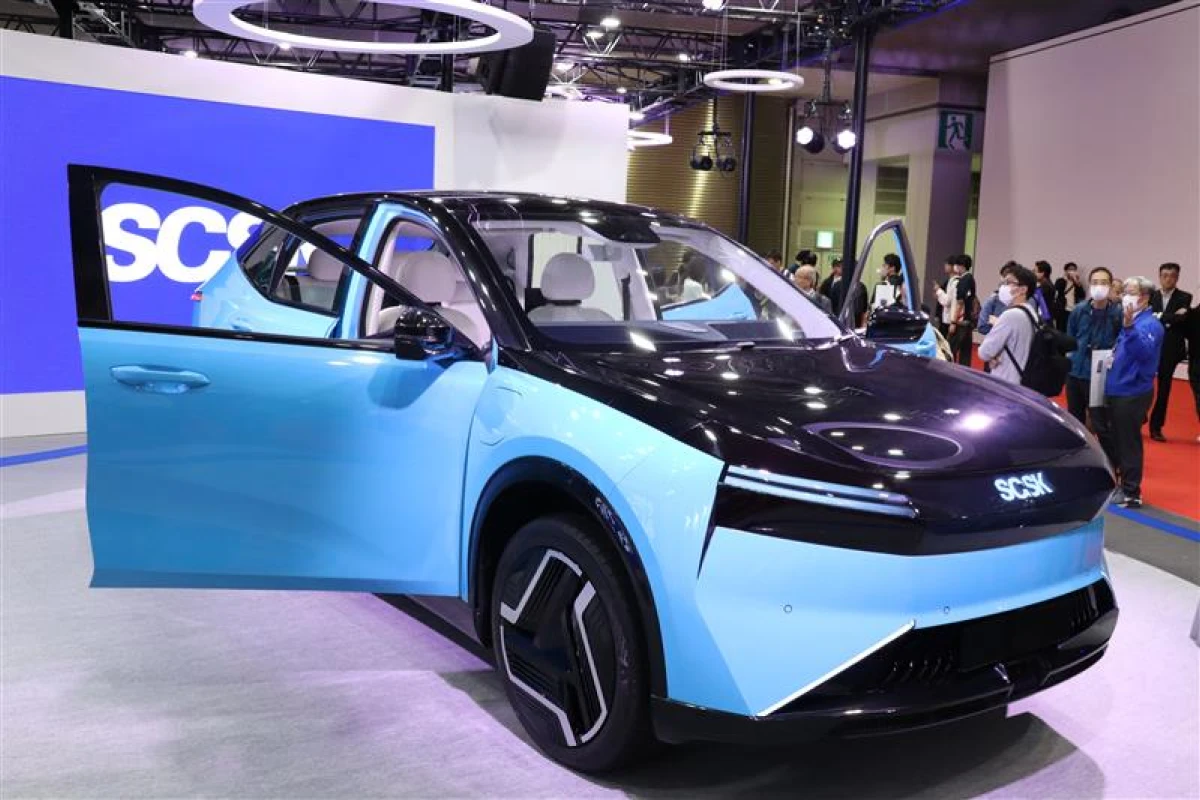
The EV displayed at JMS is not a “product.” SCSK positions it as a proof-of-concept for a “new way of making cars” centered on software. In development, the team practiced a production process suited to an era in which technologies evolve by the day and by the hour.
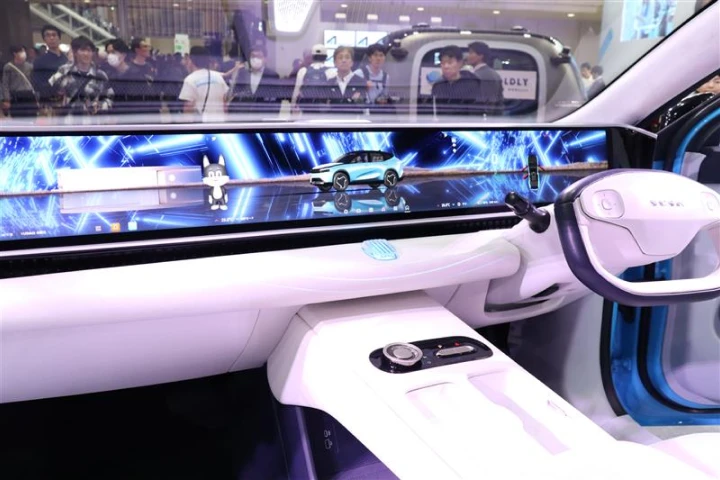
Conventional automotive manufacturing has been vertically integrated, with groups handling procurement, parts manufacturing, final assembly, and sales end-to-end. It also formed a tiered structure: OEMs at the top, followed by parts makers, then makers that supply those parts, and so on. Development was typically “waterfall” style, completing each phase before moving to the next—often taking years to finish.
This time, SCSK adopted a “sprint” approach: forming small teams and repeatedly developing and implementing in short cycles toward specific functions and value each team wanted to realize. To move fast, teams minimized time-consuming reviews and ran development in parallel; they brought their outputs together at a cadence of roughly once every one to two weeks, connecting them across teams. If something became unnecessary, development was stopped; what proved necessary was actively incorporated and refined. This method—also used by U.S. IT firms—enabled the showcased EV to be completed in just nine months. For driving-safety systems, where lives are at stake, conventional methods remain essential. But for user-driven needs outside that domain—such as entertainment—sprints can reflect requirements in software in a short time frame.
In total, around 50 companies were involved, including internal development teams. While SCSK acted as the flag-bearer, younger engineers took the lead in design. Noting that today’s mass-production model effectively targets people in their 40s and older—and is not well aligned with those in their 20s—the team focused on an EV designed with Gen Z in mind.
New value and business created by IT—fuel for talent acquisition
As future business directions, Mitani points to new IT-driven mobility initiatives such as “company cars” tailored to specific industries and companies, and deeper co-creation with the automotive industry. One example is the hotel industry: a vehicle specialized for that sector, where passengers can check in and book guided tours from inside the car—and after dropping luggage at the hotel, head straight out again. Because no one knows what will succeed, creators can generate new value and new business by imagining and ideating from the user’s point of view.
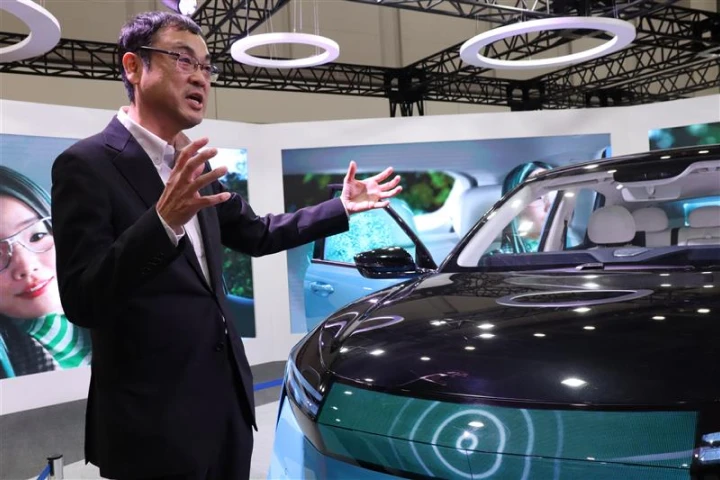
If such appeal can be communicated broadly, Mitani believes it will help attract talent. At SCSK, some IT professionals initially felt confused when assigned to the automotive division. But when they learned that in-vehicle software requires enormous lines of code—and that SDVs place great importance on software built on free and creative thinking—they realized, “This is exactly the IT I wanted to do,” and their eyes lit up.
For Japan’s automotive industry to remain competitive, Mitani argues, it depends on whether it can take distance from past success stories, revisit the origins of its development, and create new value. As one of the players, he wants SCSK to help make that happen. Many foundations of carmaking—from mass production methods to engines—are “imports.” Yet on the ground, there is often an emphasis on creating “0 to 1,” which does not always go well. Japan’s strength has been turning “1 into 10” and “10 into 100,” and he believes that will also hold true in the SDV era.
As noted earlier, the automotive industry lacks software talent for SDV development. In that environment, IT companies—because they are not suppliers belonging to an OEM group, but rather in a “flat” position—can become allies with a wide range of partners regardless of company affiliation. Moreover, listening to user voices and reflecting them in software has long been core to what IT does—and is a strength. In that sense as well, momentum is growing for collaboration with IT that crosses the boundaries of the automotive industry.
Related Articles

Other contents