Autonomous Driving AI Challenge Offers a Glimpse of the Auto Industry in the SDV Era (Part 1) E2E Hegemony Race Intensifies Worldwide
- # Human Resource Development
- # Mobility DX
A Student Team Wins in an Upset With the Fastest Time
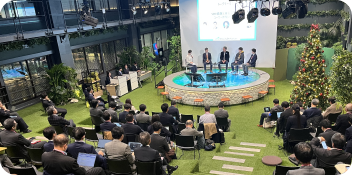
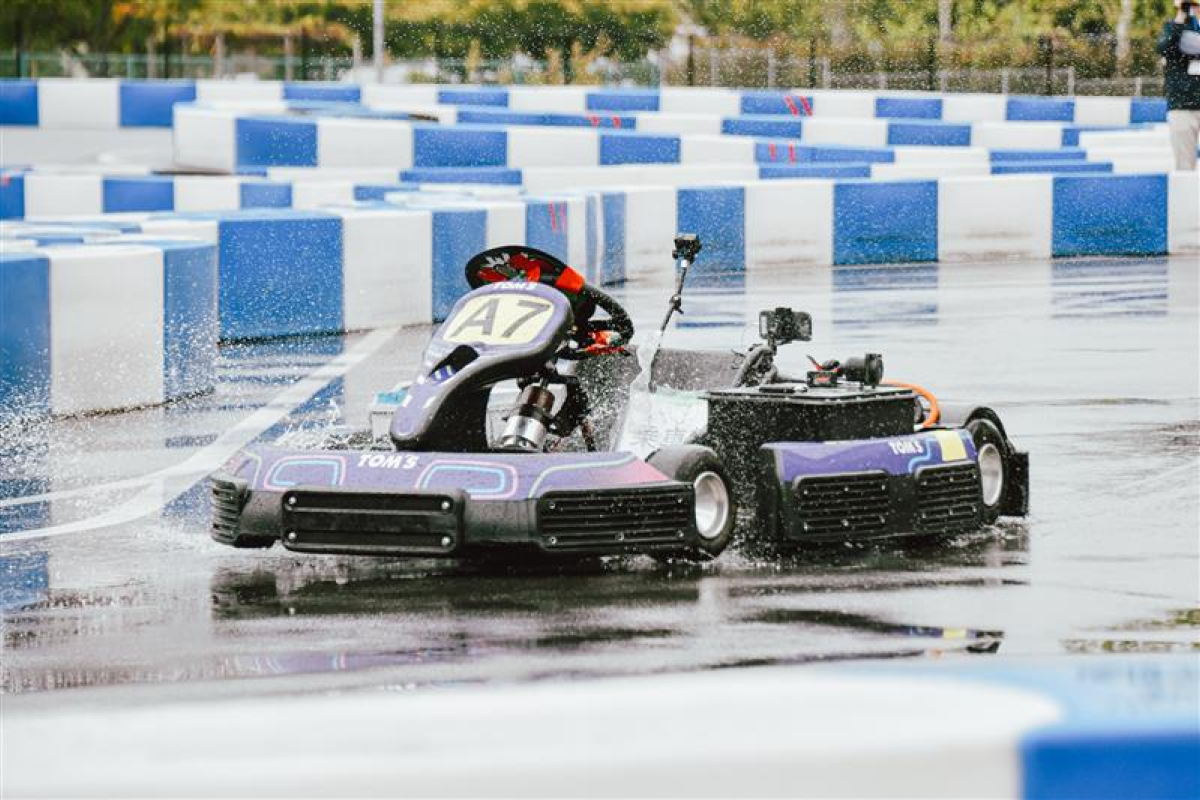
On October 25–26, 2025, the finals of “Autonomous Driving AI Challenge 2025” were held at City Circuit Tokyo Bay, a kart racing venue in Odaiba, Tokyo with a lap length of about 400 meters. What ran on the track—under harsh surface conditions punctuated by heavy rain—were unmanned karts controlled by AI. A total of 15 teams, including students and automotive engineers, competed for speed by running their unmanned karts along routes set before the race. However, real-world corners and wet pavement tended to behave differently from pre-race simulations, causing spins. Lap times ultimately depended on the ability to perceive and judge conditions—making fine adjustments to speed and corner entry to match the surface—and the skill to implement those adjustments quickly during the race.
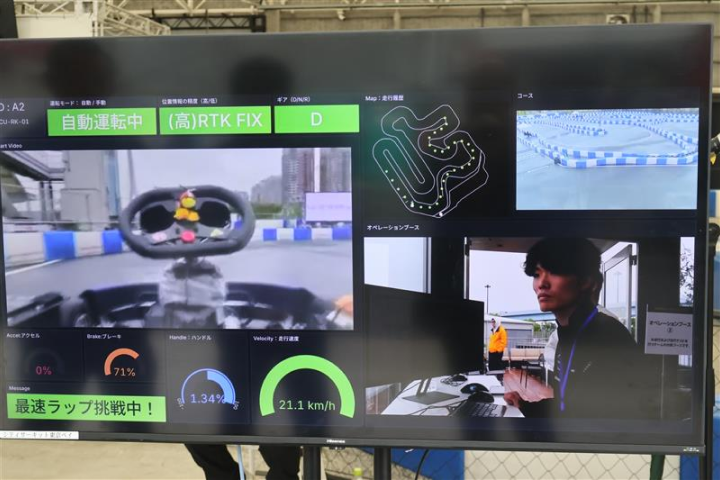
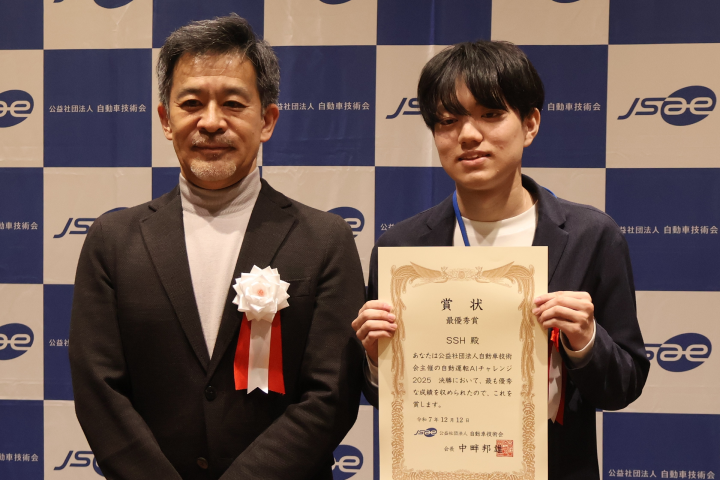
The overall fastest team, winning the top award, was a three-student team from the Faculty of Science and Technology at Keio University, competing in the “Student Class.” After analyzing qualifying-round videos to identify issues and then making adjustments late into the night, they posted a 46.032-second lap—beating the second-place “General Class” team of working professionals at 46.813 seconds. Second-year student Yuki Naeka (20) recalled, “I joined for a simple reason—because it sounded fun. Since then, the three of us have been working on it for six months.” While he said he has not yet narrowed his future path to a specific field, he appeared to have deepened his interest in automated driving together with his teammates.
About a month and a half after the finals, on December 12, an awards ceremony was held again at Kudan Kaikan in Chiyoda, Tokyo. Kunimichi Hatano, chair of the organizing committee, expressed his determination, saying he wanted to “update the competition and increase the number of peers involved.” Next, Kazunari Tanaka, Councillor of the Minister’s Secretariat at METI, noted uncertainty facing the automotive industry and encouraged participants: “Keep taking on challenges, and let yourselves—and Japan’s future—shine.” As winners including the Keio team received certificates and other honors, the venue was filled with a celebratory mood.
The Autonomous Driving AI Challenge is organized by the Society of Automotive Engineers of Japan (a public interest incorporated association), and 2025 marked its seventh year. Although it was launched to identify automated-driving engineers, participation had plateaued because the tasks—such as avoiding obstacles using sensors—were challenging even for people directly involved in the field. Concerned that the “seeds” of talent were not sprouting sufficiently, the organizers revamped the format starting in 2024, shifting to simulator-based automated driving provided in advance and a real-vehicle race, making it easier for students to take part. Compared within single-discipline competitions, participation grew from 233 people in 2021 to 397 in 2024 and 584 in 2025. The competition secretariat feels it “may become an opportunity to broaden the base of automated driving.”
The Government Also Feels a Sense of Urgency Over E2E Development and Incorporates It Into National Strategy
This competition—whose primary aim is to secure digital talent, including AI expertise, that can support automated driving—has become increasingly important. That is because how to advance and apply AI in automated driving has become a concrete trend in the international automotive industry, and the view is strengthening that it will determine the competitiveness of Japan’s auto sector. In its “Mobility DX Strategy” updated in June 2025, METI positioned “AI for safe and wide-area real-world driving toward automated driving” as a priority theme.
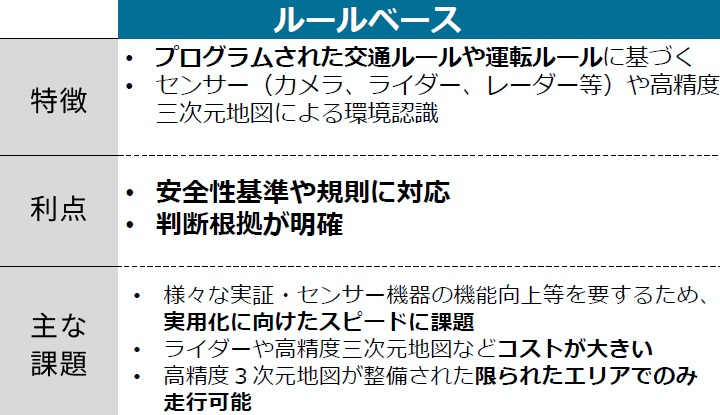
Japan’s automotive industry has so far mainly pursued “rule-based” automated-driving models. Engineers encode traffic and driving rules into programs for each function (module). The vehicle then drives by matching information it perceives—via sensors, high-precision 3D maps, and other means—against those rules. In reality, however, there are situations that are difficult to anticipate in advance, such as maneuvering around vehicles parked on narrow roads or wildlife suddenly darting out at night, and there are limits to what engineers can pre-program exhaustively. This is why rule-based approaches are said to struggle with “Level 4” under complex conditions.
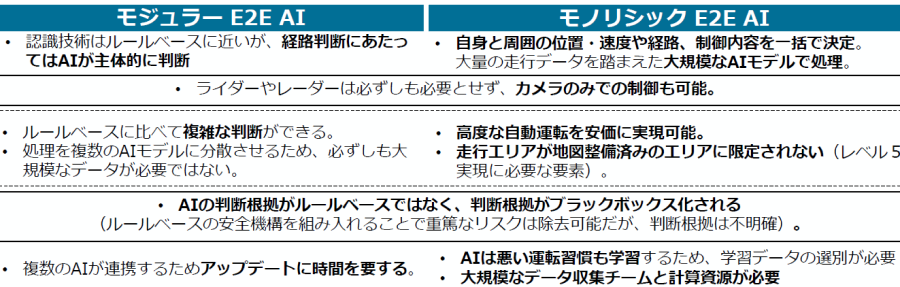
Meanwhile, in recent years, development competition has been intensifying worldwide around a technology known as “E2E.” It is a technique that uses a single AI to do everything from situation recognition to driving-route decision-making.
In ordinary human driving, a driver infers and judges whether a situation is dangerous based on surrounding cues—such as a person’s silhouette—and responds flexibly without straying egregiously from rules. E2E is the concept of having AI take on that role; if a vast amount of training data can be assembled, it may become possible for AI to drive in a human-like way even in irregular situations that rule-based systems could not fully handle. For automakers, another advantage is the potential to reduce the enormous cost of defining rules.
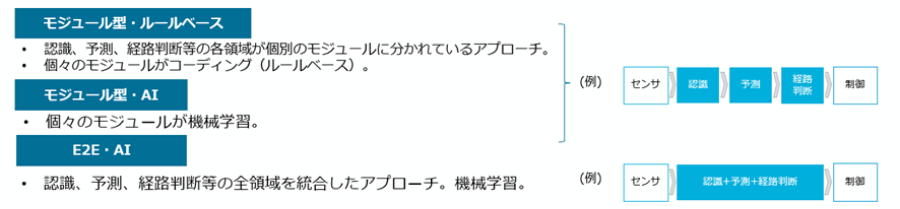
Globally, Tesla implemented an AI-based E2E automated-driving function in 2024, while in China, tech giant Huawei began supplying AI-based ADAS (advanced driver-assistance systems) to Chinese automakers. Development is also heating up in Europe, and in Japan, startups such as TIER IV, Inc. and Turing Inc. are advancing E2E development as well.
Both Rule-Based and E2E Have Pros and Cons at Present
At this point, E2E cannot necessarily be said to hold a clear advantage in automated driving. As infrastructure, it demands personnel capable of collecting data at scale and compute resources such as high-performance GPUs (graphics processing units). Even if an accident occurs, AI decisions are a “black box” that cannot be analyzed objectively, raising concerns that it will be difficult to identify causes and immediately translate findings into safety and reassurance.
That said, if in the future enough data can be gathered for AI to make accurate judgments and E2E performance can be raised fully—and if E2E safety can be evaluated—then wider adoption of “Level 4” enabled by E2E will start to look more realistic. Considering expansion into overseas markets, if domestic automakers do not seriously commit to E2E, they risk eroding international competitiveness and share. Against this backdrop, efforts to attract digital talent into the automotive industry—including initiatives such as the Autonomous Driving AI Challenge—are ramping up in earnest.
A Young Engineer: “I Want to Balance the Joy of Driving With Avoiding Danger”
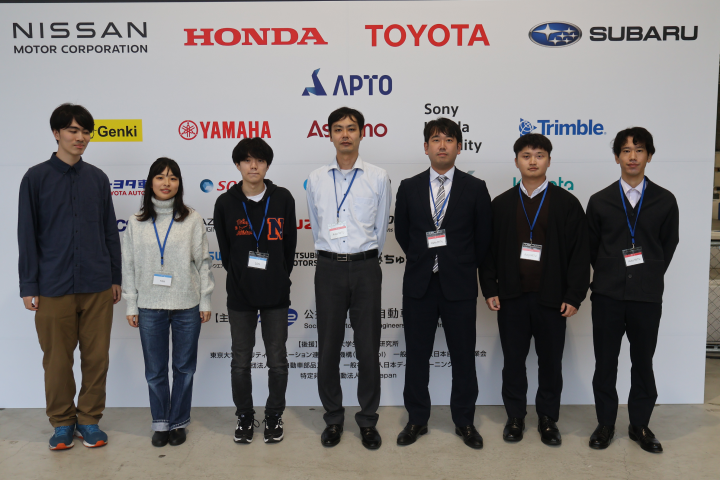
Hiroki Hayashi (26) of Mitsubishi Electric Software Corporation, who participated in this year’s competition, explained his motivation: “I entered the industry simply because I love cars. I want to pursue automated-driving vehicles that preserve the joy of driving while also balancing that with support for avoiding danger.” If more young people like Hayashi spread that desire to share the appeal of cars, it could become fertile ground for diverse talent to gather beyond the existing boundaries of the automotive industry.
Next time, regarding automated driving and AI, we will publish an interview with a key Honda figure involved in automated driving.
Related Articles
-
- # Collaborative Partnership
- # Mobility DX
2026.02.25
-
- # Collaborative Partnership
- # Mobility DX
2026.02.25
-
- # Interview with the METI
- # Mobility DX
2026.02.25
Other contents