Autonomous Driving AI Challenge Offers a Glimpse of the Auto Industry in the SDV Era (Part 2) Talking With Key Honda Figures Driving Digitalization
- # Collaborative Partnership
- # Mobility DX
Kunimichi Hatano, Chair of the Autonomous Driving AI Challenge Executive Committee (Executive Chief Engineer, Honda Motor Co., Ltd.)
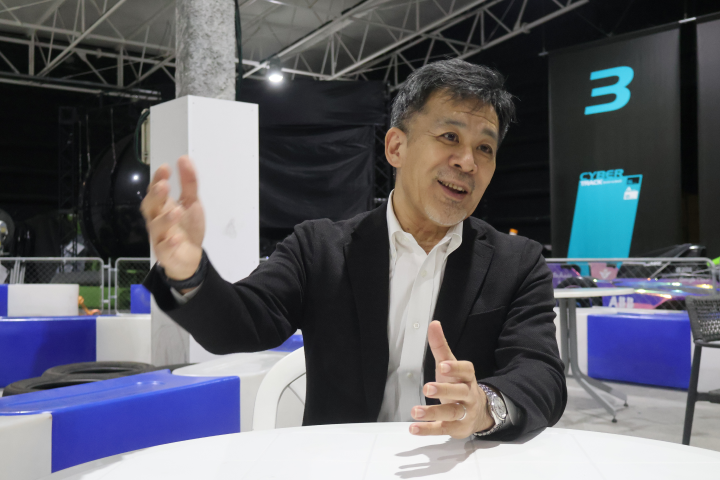
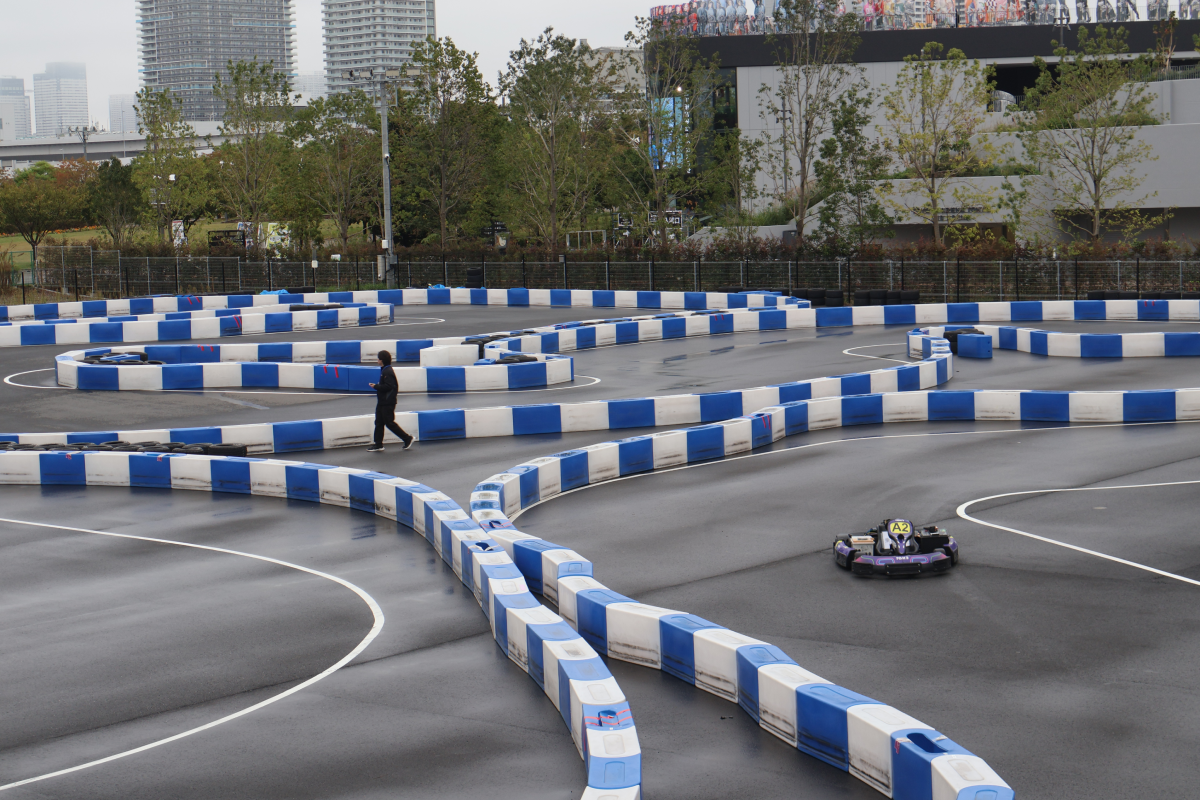
This competition allows participants to run a real vehicle, confront a variety of challenges, and experience the “reality” of manufacturing through trial and error. At a time when ICT (information and communications technology) talent tends not to take interest in the automotive sector, we hope the event will invite a wide range of students and working engineers—helping them build skills while also giving them an opportunity to become interested in the industry.
A notable feature this year was that student teams were not “writing in” code (programs) to execute automated driving; instead, they actively used AI for tasks such as route setting. In other words, for students about to enter society, I felt it is becoming more important than programming technique to think seriously about “what they want to achieve.” Meanwhile, for engineers, it can be said that they need the ability to assess—drawing on knowledge students do not yet have—whether the means proposed by AI are truly correct.
The Automotive Industry Is Shifting From a “Hierarchy” to a “Mix” Structure
If industry as a whole—including automotive—fails to regain past momentum, struggles to attract talent, and then falls into a spiral where it becomes even harder to build momentum, that would amount to a crisis for Japanese industry. Looking at the automotive sector, in the past, OEMs (vehicle manufacturers), positioned at the top of the industrial structure, demanded that suppliers build products in line with demand. It can be said that “top-down requirements” functioned precisely because OEMs—one of whose main jobs is to directly grasp customer needs at dealerships—could do so. But now that ICT has become extremely important in automobiles, that approach no longer holds. Suppliers, too, can reflect consumer needs in products through ICT. The industry’s structure is no longer a hierarchy; instead, OEMs and suppliers are increasingly becoming mixed together.
Over many years, the automotive industry has accumulated know-how in “product assurance work” as a crucial part of its job to protect customers’ lives and property. This is a strength the industry has cultivated from a perspective different from simply applying advanced technology, and it will not be easy for new-entrant industries—even those leveraging AI—to catch up quickly. Still, that does not mean things can remain as they are. AI, trained on enormous volumes of data, could eventually cover areas that today are seen as the industry’s strength.
Regarding the current state of automated driving, both “rule-based” approaches—where engineers predefine items such as automotive regulations—and “E2E,” in which AI covers everything from recognizing the surrounding situation to driving and control, have their own strengths and weaknesses. It is not something for which we can immediately judge which is more suitable. For example, in terms of safety, rule-based approaches currently have an advantage because they can make use of the industry’s accumulated know-how, but they are weak in situations not predefined in advance—such as “crossing into a no-passing lane in order to avoid a vehicle parked on a narrow road.” That said, E2E also cannot handle completely unseen situations, and even if it judges “it should be safe” based on massive datasets, it is not absolute—just as human driving is not absolute.
It Is Important to Use Technology in Line With What You Aim to Achieve
The two approaches are merely differences in methodology toward automated driving. It is necessary to examine appropriate technical means depending on what you want to achieve and what you want to protect. In moving toward automated driving and SDVs, we have entered an era in which we must involve and collaborate with other industries, including digital sectors.
An automobile is hardware that is always “real”—a complex mechanical system accompanied by physical constraints. We control it using digital technologies, including AI, and update it in line with customer needs. By linking cutting-edge software and hardware, we can change people’s lives and society. For ICT talent, it is also an extremely dynamic and attractive line of work.
Kazuya Yamamoto, Member of the Autonomous Driving AI Challenge Executive Committee (Chief Engineer, Honda Motor Co., Ltd.)
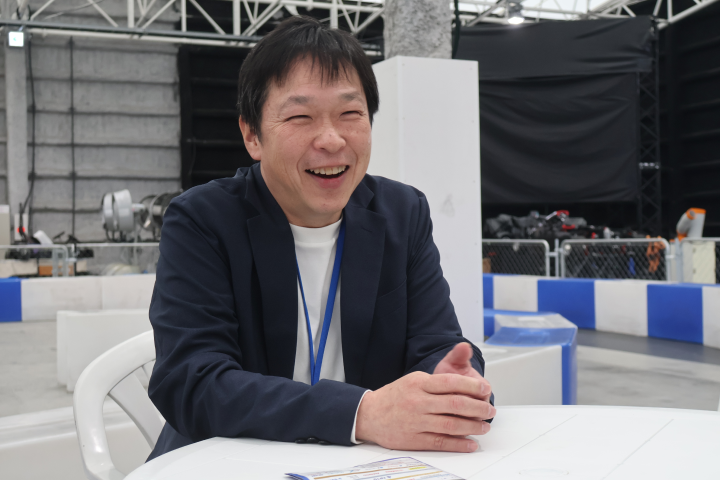
In the digitalization of mobility, Japan is slightly behind Europe, the United States, and China. In particular, SDVs require development with enough speed to compete with overseas players, as well as regular software updates aligned with user needs. To continue expanding business globally, securing talent capable of handling software is an urgent issue. However, such talent does not readily gather in Japan’s automotive industry. The shortage in absolute numbers has become a major challenge.
One part of an industry-wide solution can be described as the “Autonomous Driving AI Challenge.” We hope it will become an opportunity for students—who will be responsible for future automated driving and SDVs—to feel the automotive industry’s appeal. Previously, for example, it was a competition in which a sensor-equipped autonomous golf cart had to clear challenges such as avoiding obstacles, but in terms of required specialization, the hurdle for students in particular was simply too high. Therefore, we adopted rules that make it easier even for beginners to participate: using only a GNSS sensor (with GPS being one such system) that identifies position via satellites, teams set the course route. As a result, student participation—including high school students—has increased, and we feel the base is broadening.
Looking ahead, we are considering establishing a competition that uses E2E, which tends to attract people with advanced technical capabilities. It is unclear whether rule-based approaches or E2E will become mainstream, but when we consider future technological evolution and the possibility of massive data accumulation, we need to keep E2E in view starting now.
An Industry That Creates the Future “Real” Society Through ICT
Demand for E2E is particularly high in rural areas, where cars are an essential means of transportation. As aging progresses, if people can freely reach hospitals or supermarkets in a short time without driving, it could also lead to regional revitalization. At the same time, in developing automated driving going forward, it will also be important to determine how to leverage the rule-based advantage of meeting consumer needs through a sense of reassurance.
Digitalization of automobiles further enhances the sense of fulfillment in working in the industry. Rural aging is a serious social issue not only in Japan but also in other Asian countries. The automotive industry has very high potential to solve these challenges and change society. I want to call on the young people who will carry the next era: “Let’s create the future ourselves in the automotive industry.”
Related Articles
-
- # Human Resource Development
- # Mobility DX
2026.03.05
-
- # Collaborative Partnership
- # Mobility DX
2026.02.25
-
- # Collaborative Partnership
- # Mobility DX
2026.02.25
Other contents