What Skills Are Needed? How to Make Use of the SDV Skills Standard Can it become a “nautical chart” that guides the securing of software talent?
- # Human Resource Development
- # Mobility DX

SDV-Era Changes in Vehicle Value and Core Talent
In the “Mobility DX Study Group” launched in FY2023 by METI, SDVs were identified as one element that would drive transformation in the automotive industry. Like smartphones and PCs, a wide range of functions can be added and updated via internet-based updates, enabling value tailored to user needs to be provided rapidly and flexibly on an ongoing basis. This represents a major shift for users as well, because it overturns the “sell-and-done” concept of cars—where value is highest right after purchase.
Until now, installing software such as control systems required time-consuming “tuning and integration” with various parts (hardware). With software-led development enabling functions to be added more easily, a major improvement in development efficiency is expected. In addition, expectations are high for the creation of new businesses around automobiles—for example, providing information and entertainment (infotainment) in subscription form. In the SDV era, the core of the automotive industry is considered to be the people who develop software.
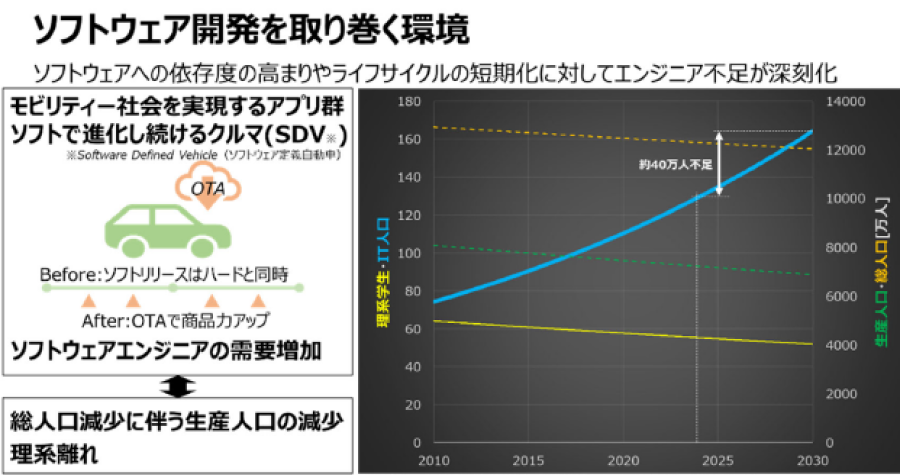
However, even as Japan’s labor force population is declining, software engineers are already in a severe shortage—both in quality and quantity—and this is especially apparent in the automotive industry. One reason is that conventional career systems do not fully cover the specialties required for SDVs, such as cloud, AI, and software design—putting companies at a disadvantage in the talent competition with the IT industry, where those specialties are clearly defined. According to the working group (WG), a fixed notion remains strong among students who study information and communications—that “cars are centered on mechanical technologies.” In FY2023’s job market, while job postings for software-related roles surged, the number of applicants did not increase accordingly.
There Are Limits to In-House Training When Know-How Is Scarce
To make up for the talent shortage, OEMs (vehicle manufacturers) have relied on parts suppliers (Tier 1) for software development. In some cases, Tier 1 suppliers further re-outsource to specialized software companies (Tier 2). Meanwhile, as global development competition for SDVs and next-generation mobility intensifies, some Japanese OEMs have begun adopting an “agile” approach—repeating design, implementation, and testing in short cycles to create products that match market needs—rather than the traditional “waterfall” approach of completing each phase before moving to the next. One major company reportedly sets this cycle at about two weeks. When work is outsourced and re-outsourced to parts manufacturers and others, negotiations—including specifications and pricing—can take months, which is not suited to SDV development that demands speed. As a result, the need to secure software talent in-house has risen to an unprecedented level.
Nevertheless, training software specialist talent suitable for SDVs is an unknown domain for many automotive-related companies. As noted above, roles, expected skills, and future career paths are not clearly defined, and even if people are hired from other industries, a mismatch with actual work may occur. In response to requests from the automotive industry facing these issues, JSAE established the “Automotive Software Domain Human Resource Development Working Group (WG)” and began activities in 2022. The WG discussed: (1) examining a taxonomy for the automotive software domain, (2) defining the needed talent profiles and the required training, and (3) examining the scope JSAE should address, including certification systems.

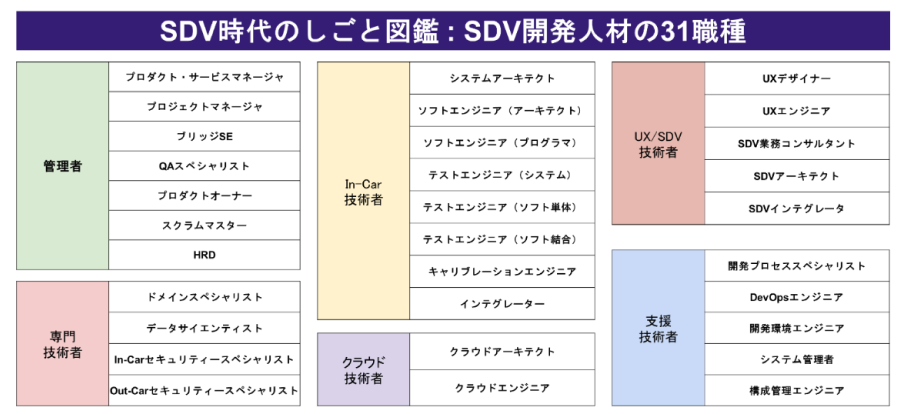
As a result, the “SDV Skills Standard” was born. After establishing (a) the “Automotive Software Domain Technology Map,” which comprehensively covers the skills required, and (b) “Career Definitions” for job categories, it specifies concrete skills and levels by role. The base model was ETSS (Embedded Technology Skill Standards), established in 2005. For the career definitions, the WG extracted SDV-related roles from software-related positions at companies including Toyota Motor Corporation and defined 31 job types. Professor Hiroaki Takada—Director of the Mobility Society Research Institute, Institutes of Innovation for Future Society at Nagoya University, who chaired the WG—explains: “Each company differs in its methods of talent development and its technology categories. With that as a given, we compiled what is likely needed into a common-denominator knowledge taxonomy.” The standard is intended to be used flexibly by each company. For individuals, it can serve as a reference to identify “which skills are missing for the role I want” and “what I should learn.” For companies, it can help them identify “what talent is lacking to advance SDVs” and “which areas are strengths that should be further developed.”
The Technology Map and the 31 Career Definitions Form the Foundation
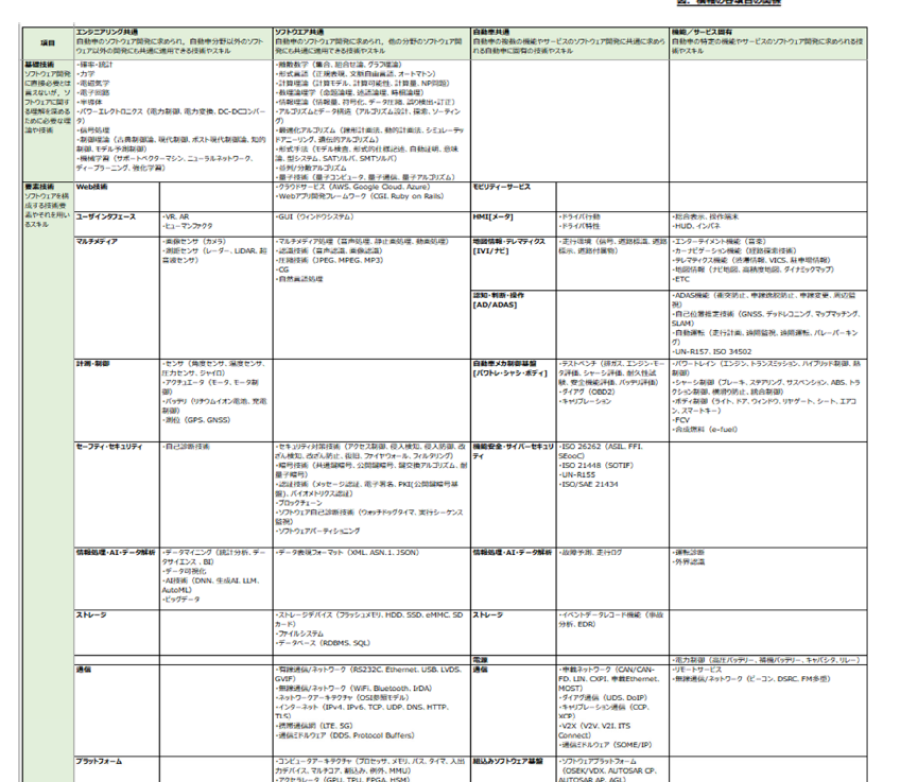
On the horizontal axis, the Automotive Software Domain Technology Map shows the fields in which skills can be applied. Put in simpler terms, it is divided (from left to right) into: (1) development that includes fields beyond software, (2) software development, (3) “automotive” software development, and (4) “specific” automotive software development—such as entertainment, car navigation, and automated driving. In other words, the leftmost skills are the base, and the further right you go, the more specialized the skills become. Professor Takada explains it with a cooking analogy: “The far left is a universally useful technique, like how to cut vegetables; the far right is the technique for making a specific dish, like ratatouille.”
Meanwhile, the vertical axis is divided into skill categories. Specifically, it includes: “Foundational technologies,” which are academic knowledge mainly learned at universities (such as mathematics); “Elemental technologies,” which relate to individual domains such as user interfaces, multimedia, and information processing/AI data analysis; “Development and operations technologies,” which implement those elements; and “Management technologies,” exemplified by product managers who coordinate software development involving many people. The skills required are written within the cells where the vertical and horizontal axes intersect.
The career definitions further subdivide the job types shown in ETSS. Including additions such as “Software Engineer (Architect),” specialists who design SDVs, and “In-Car Security Specialist,” who handles cybersecurity software installed in the vehicle itself, the roles were redefined into 31 job types.
The Higher the Career Level, the Greater the Quality and Quantity of Skills Required
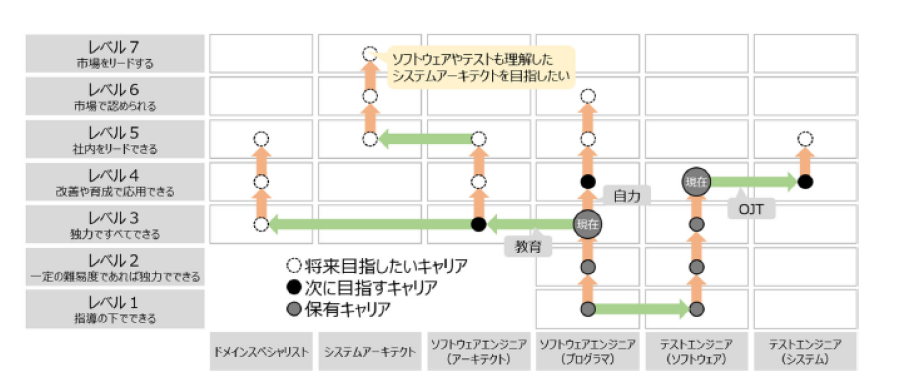
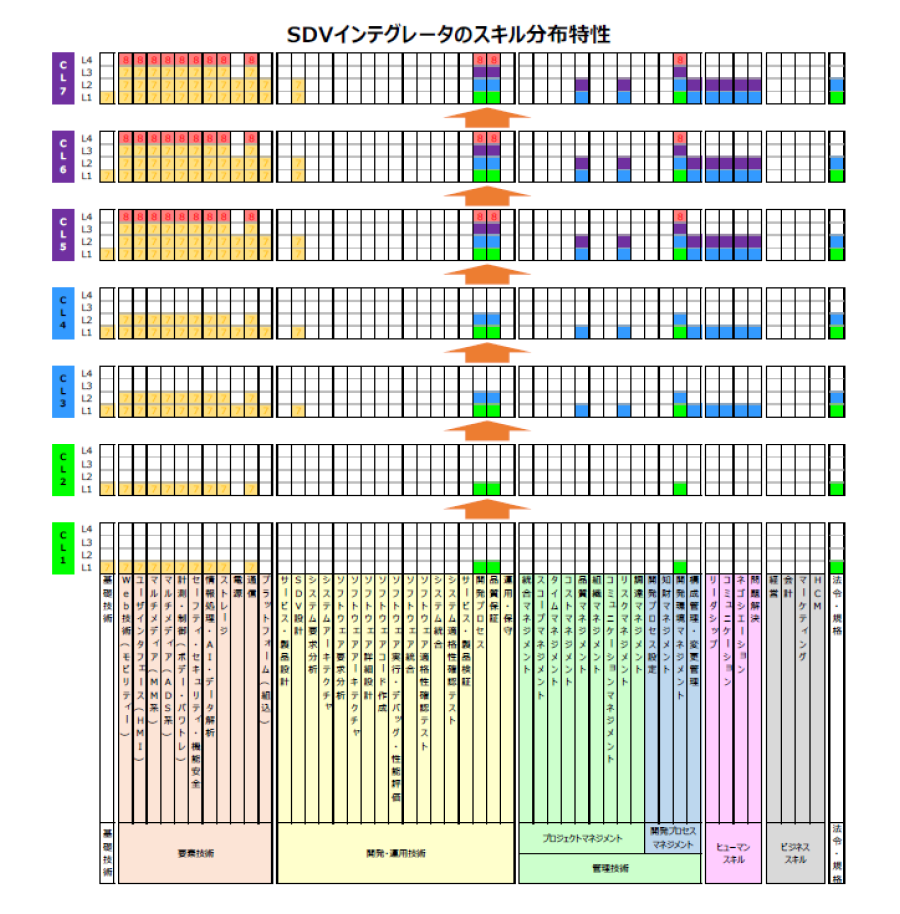
What is called the “SDV Skills Standard” is created by matching each role in the career definitions with the technology map. It has skill standards from Level 1 to 4, and career standards from Level 1 to 7. The higher the career level, the broader the required skill types and the higher the required skill levels. Career Level 1 is “can do it under guidance,” and Level 2 is “can do it independently if the difficulty is within a certain range.” Level 4—“can apply it through improvement and mentoring”—is positioned as the level expected of a team leader. At Levels 6 and 7, the skills are so advanced that they can influence the market, and those who qualify are extremely limited.
The SDV Skills Standard guidebook compiled by the WG shows concrete criteria for each role. For example, for an “SDV Integrator,” at Career Level 1, skill levels of 1 are sufficient for each area such as elemental technologies and development processes, and for development/operations technologies such as quality assurance. At Career Level 4, many skill levels become 2, and at Career Level 6 and above, a level of 4—the highest—is required in most areas. The overview section also lists concrete deliverables (outputs) by role in an easy-to-understand way. Professor Takada notes: “The IT field advances day by day. More than specific technologies, it becomes important to pass down how to learn and to build the ability to apply knowledge. I want people to use this as one of the tools for that.”
Broad Use Through Linkage With the “SOMRIE(r) Certification Program”
The SDV Skills Standard has only just been completed, and widespread adoption lies ahead. As a challenge, the guidebook points out that if definitions remain specific to the automotive industry, understanding outside the industry will not progress and “siloization” (competition for talent within the industry) could intensify. To operate it with a view toward collaboration with outside parties—such as the specialized software talent needed for SDVs—the standard is to be linked with other “skill standards.” One example cited is Denso’s “SOMRIE(r) (sommelier) Certification Program.”
Denso had been exploring a system for developing software talent even before SDVs drew attention, and began operating it in FY2021. Referring to skill standards for software-related work across society, it defined 18 highly abstract and universal “capabilities” and created a map. The capabilities are classified into four elements: “development technology elements,” “specialized technology elements” such as data analysis, “management elements” that coordinate organizations, and “social value creation elements” that build businesses and implement technologies.
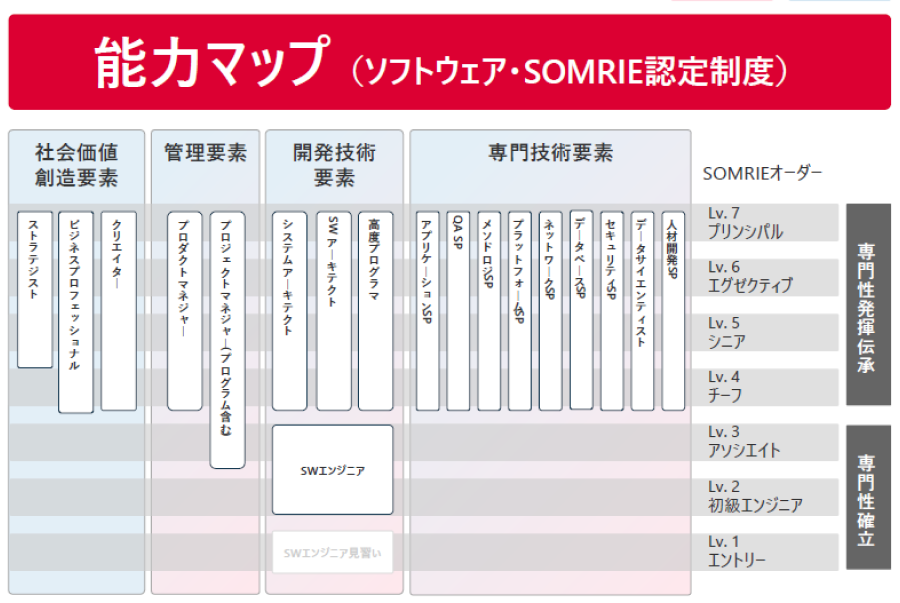
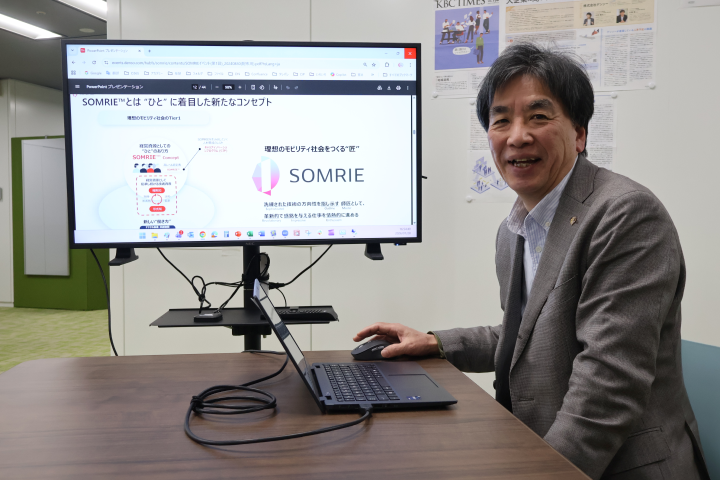
The biggest feature of the SOMRIE(r) program is that it is an “open and bold talent-strengthening mechanism” that does not remain confined to Denso’s internal use. By not specializing its content for the automotive industry and instead abstracting and universalizing it—and by using it in combination with the SOMRIE(r) program—it is argued that “by integrating (linking) it with automotive-specific definitions, SOMRIE(r) capabilities can serve as a common language, ensuring connections with Japanese industry.” The program could thus ripple into greater talent mobility across industry. It is also expected to serve as a basis for judgment for companies and individuals that want to work on SDVs—linking the required technology domains with the 31 job-type career definitions shown in the SDV Skills Standard. JSAE and others are currently working on mapping how the 18 capabilities connect to the 31 job types. In addition, because the SOMRIE(r) program has been in place for some time and its education system is well developed, using related existing and new courses is also being considered.
Tomokazu Hirose, Deputy General Manager in Denso’s Soft Career Support Office, said: “The SDV Skills Standard will be extremely important for the automotive industry going forward. But if we stop there, it becomes a story only about the automotive industry. When thinking about human resource development with a view to collaboration with other industries, we need to raise the level of abstraction of job definitions—and we believe it would be good if we can express them in terms of capabilities.”
Related Articles
-
- # Human Resource Development
- # Mobility DX
2026.03.05
-
- # Collaborative Partnership
- # Mobility DX
2026.03.05
-
- # Human Resource Development
- # Mobility DX
2026.03.05
Other contents