“Autonomous Mini Car Battle” Sparks Interest in the Auto Industry, Laying the Groundwork for Talent Development Made possible through a partnership between “42 Tokyo” and corporations, with wider access for participants
- # Human Resource Development
- # Mobility DX
Frustrated in Defeat, Yet Satisfied — Autonomous Driving From the Ground Up
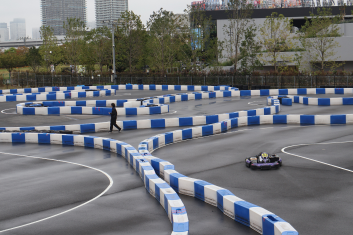
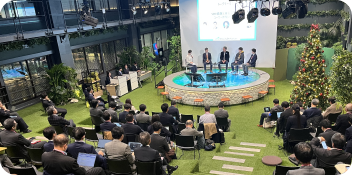
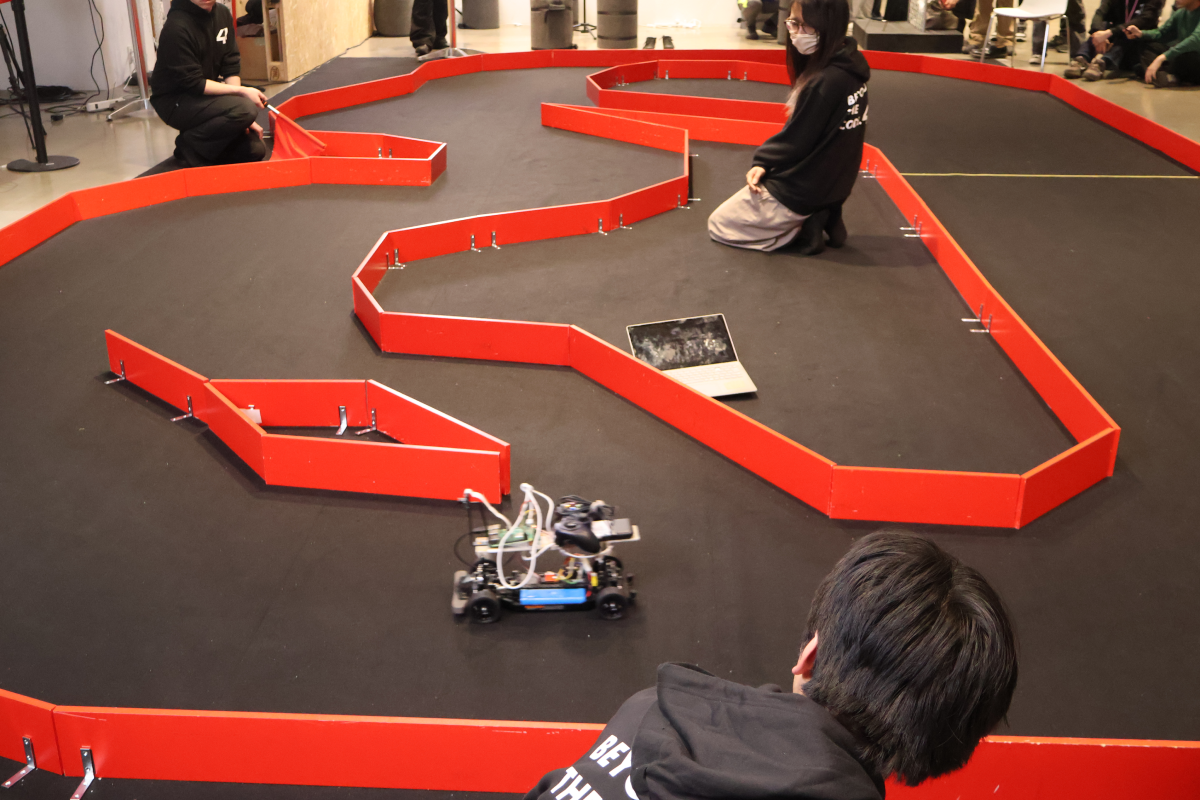
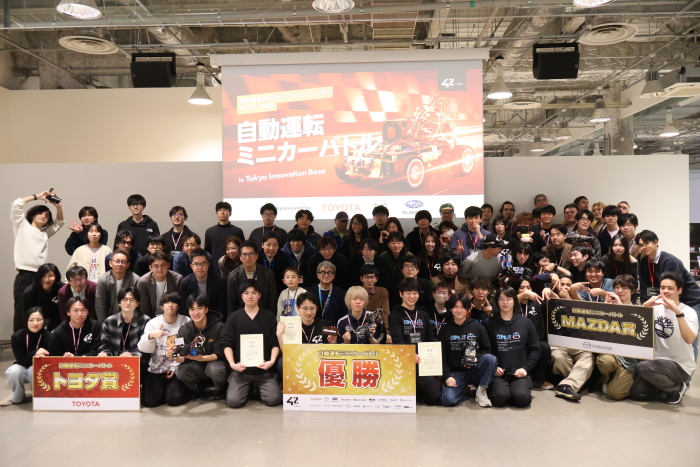
February 15, 2026. At the final competition held at Tokyo Innovation Base in Yurakucho, Tokyo, the determination of participants—committed both to winning and to the technology they had developed—made the venue even more intense.
The Mini Car Battle has been held since 2024 as a place where future engineers can realistically imagine themselves thriving in the future, at a time when software has become as important as hardware in the automotive industry. The event was originally sparked by Toyota Motor Corporation, a sponsor of 42, which had been holding an autonomous mini-car competition for working adults. That led to discussions about whether a similar initiative could be organized for students in order to help cultivate the talent that will support the future of the automotive industry. The first event was hosted by Toyota, and participation was limited to 42 students. However, because participant feedback was highly positive, many called for it to continue, and the event was carried forward. From fiscal 2026, participation was broadened to include people outside the school as well as members of the general public. In addition to automotive industry partners such as Mazda and SUBARU, companies from other sectors also joined as event partners, with support from the Ministry of Economy, Trade and Industry and the Digital Agency. A total of 246 people in 78 teams applied, and more than half of them were working adults.
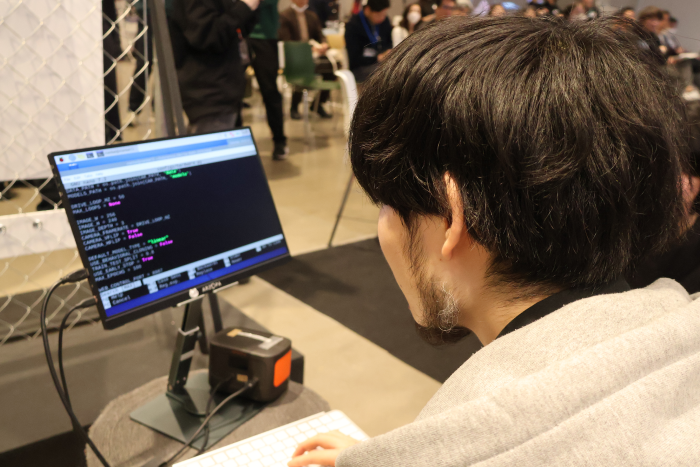
The rules are strict. The budget is capped at ¥50,000. The only devices permitted for autonomous-driving control are a camera and ultrasonic sensors. Participants must create their own driving programs and software, and once the race begins, the cars must run fully autonomously, with performance adjusted through program changes and the like. Even so, participants are allowed to receive advice from Toyota Motor and others. Each run lasts six minutes, and the competition is based on the fastest time recorded while completing three laps. There is a shortcut along the course, but because it includes either highly complex or very sharp turns, attempting it carries the risk of crashing into the walls.
At the final competition, the team that had placed first in qualifying was so fast that many other participants focused not only on machine control but also on speed. Whether because last-minute adjustments failed to come together or for other reasons, one vehicle after another was unable to complete three laps, veered off without running straight, or slammed into the course walls because it could not make the corners. As restarts continued, the six-minute time limit drew closer. Yet even in situations where finishing the course seemed difficult, many participants kept discussing what to do within their teams, adjusted their programs, and continued taking on the challenge. In the end, the qualifying leader won in dominant fashion. At the award ceremony, those who did not receive prizes showed their frustration, but also the look of people who had given it everything they had. Yoko Sakanoue, Chair of 42, summed up the event with emotion and joy, saying, “Everyone was challenging themselves to beat the first-place team. Seeing that moved me to tears.”
“42 Tokyo” Without Teachers — Training Engineers Through Peer Learning
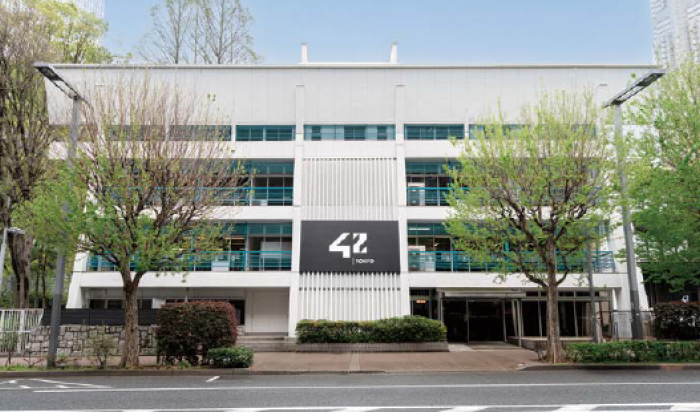
42 was founded in France as a specialized institution for training engineers. It is now present in 31 countries. One of its campuses, 42 Tokyo, opened in 2020 and is currently located near the Tokyo Metropolitan Government Building in Shinjuku, Tokyo. Its mission is to help address the shortage of engineers and to reduce disparities in educational opportunity caused by economic and other factors, a global issue that affects Japan as well. For that reason, students can study free of charge regardless of academic background or work history, with operating costs covered by sponsors including Toyota Motor, which supports the institution’s mission. One distinctive feature is that the campus is open 24 hours a day, 365 days a year, and has neither textbooks nor “teachers.” Instead, by learning and competing alongside one another, students thoroughly cultivate the communication skills essential for engineers working on the front lines of industry, as well as a lifelong drive to keep learning.
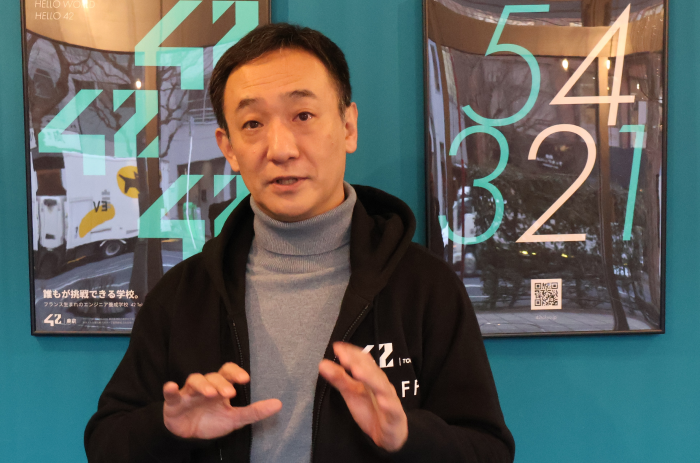
The program begins with a foundational curriculum focused on how applications and programs work, lasting from one year up to a maximum of two years, followed by a specialized curriculum that can run for as long as four years and six months. Although the school accepts students regardless of academic background or work history, even the foundational stage includes assignments such as “building small-scale infrastructure in a network” and “developing a web-based game”—tasks that are difficult to solve without the willingness to learn independently. Since there are no teachers in the conventional sense, as there are in ordinary schools, importance is placed on asking peers for help and carefully explaining things when asked, and these efforts are made visible through a points system. Daigo Sato, Vice Chair of 42, says, “If students exceed their enrollment period, they are expelled. Because the school is always open, they must discipline themselves and maintain an open mind toward other students.” At 42, students are encouraged to engage in 35 to 50 hours of self-study per week, and many take a leave of absence from school or work.
In other words, students’ determination to become engineers who can compete globally is put to the test. That is evident from the entrance process itself, in which applicants spend 26 days tackling difficult problems while seeking advice from current students and fellow candidates. Those who pass—fewer than half of all applicants—come to campus for an average of eight to 10 hours a day. While 42 does maintain a kind of career consultation desk for students, it does not approach companies asking them to hire its students. Taking action toward the future is, fundamentally, up to the students themselves. Even so, while broadening access, 42’s demanding educational philosophy and curriculum for cultivating the skills needed in society have won recognition from companies struggling with a shortage of engineers, especially in software-centered fields, and many graduates are now working on the front lines of industry. Some also choose to go on to universities in Japan or abroad after first acquiring these skills.
Mini Cars Deepen Interest in Automobiles — “The Technology Is Incredibly Impressive”
Keiichi Chikuhara, 22, and Yuka Ochi, 20, both studying at 42, took part in the Autonomous Mini Car Battle and advanced to the final. Although they did not place, the two aspiring engineers came away with a strong sense of the significance, fascination, and difficulty of working with automobiles.
Ms. Ochi took a leave of absence from the National Institute of Technology, Oita College, in Oita City and moved to Tokyo. During a company visit, she heard about graduates of 42 and became interested. “My father is an engineer, and I had decided I wanted to become one too. So it caught my attention,” she said. Although 42 was not well known in her hometown, her parents and teachers at the technical college casually encouraged her, saying, “Sounds good. You should go.” Looking back on leaving Oita and jumping alone into the environment at 42, she said, “It felt so natural to me that I didn’t really have any other set of values.” Chikuhara, who listened to her with admiration and said, “That’s amazing,” is from Kyoto and had long been deeply interested in computers and physics. He is currently studying information engineering at a university in Tokyo and describes himself as “hardcore science-oriented.” A junior student at university introduced 42 to him, saying, “There’s this place called 42, and I think it would suit you.” He took the entrance exam because it sounded like an interesting opportunity to do things he had never done before. Like Ochi, he is now also on leave from school.
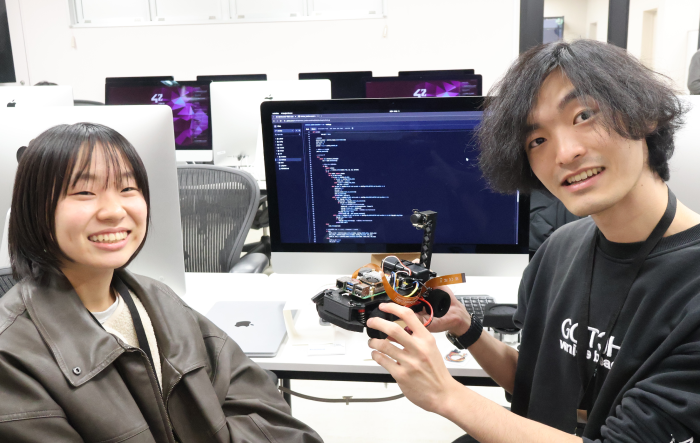
The Mini Car Battle changed both participants’ values and the way they think about the automotive industry. Chikuhara had originally been interested in quantum computing and wanted “to create something with my own technology that would make society happier.” Through the competition, however, he came to realize keenly that technology does not come together through technical capability alone; it is the culmination of a series of elements, including meeting deadlines and generating the money needed to build hardware through sales. The team consisted of five people, including three others, and all of them started out with no knowledge whatsoever of automotive technology. Each member drew fully on their own strengths, researched through books, the internet, and AI, and when they still could not find answers, they actively sought advice from Toyota engineers.
Even so, the mini car could barely make it through the very first corner. That situation continued until the day before the qualifying round, and Chikuhara recalled the mood within the team as being “like a wake.” They worked late into the night on the eve of the race, and one team member even stayed up all night at the campus. Then came qualifying day. Contrary to their gloomy expectations, the mini car made the corners smoothly and successfully completed the three laps needed to post a time. The team finished fifth overall and advanced to the final, and Chikuhara said, “I honestly felt like I was going to cry.” In response, Ochi nodded and said, “We really were a great team of five.”
Before taking part, Chikuhara’s image of automobiles had been vague: “big,” “fast,” and “cool-looking.” That view changed dramatically. “We had an incredibly hard time getting even a mini car to run properly. So the fact that Japan builds automobiles that are that large and that precise, yet still run without breaking down and drive Japanese industry forward, is truly amazing,” he said excitedly. Ochi was equally impressed. “When it rains, water gets in from above and below. And yet it still works,” she said. Against that backdrop, Chikuhara spoke about the automotive industry in the SDV era, saying, “I’m extremely interested in it. It’s hard for technology to be conveyed to people, but I realized that automobiles are one way of making that happen. Autonomous driving in particular—if the technology advances far enough, to put it extremely, you could have a baby alone in the car and send it a long distance. That aligns with my own goal of using technology to make society happier.” Then, gazing at the team’s mini car in his hands, he repeatedly exclaimed, “It’s so cute,” expressing his attachment to the hardware that moved through software they themselves had created.
Hopes for Producing the Software Talent Needed to Support the SDV Era
Mr. Sato of 42 says of the SDV era: “One reason Japan is now facing a shortage of engineers, particularly in software, is that the humanities and sciences are too rigidly separated. At the same time, the interfaces engineers use today are far easier to understand than they used to be, so the barrier between the two is lower. To help address the talent shortage, we want to send the message that this is not a field reserved only for science-oriented people.” Yoshiyuki Sasayama, General Manager of the Powertrain Group at Toyota Motor, who also belongs to the company’s HR division, spoke after the final race of the Mini Car Battle, saying: “We sympathize with the participants’ desire to change society through the power of software and to improve their technical capabilities. When things do not go well, they discuss within the team what should be done and then put it into practice. That has something in common with Toyota’s spirit of kaizen—reviewing work, improving efficiency, and raising quality. Even if they know nothing about automobiles, we want to support the creation of people who can take on new challenges on their own.”
Related Articles
-
- # Human Resource Development
- # Mobility DX
2026.03.05
-
- # Human Resource Development
- # Mobility DX
2026.03.05
-
- # Collaborative Partnership
- # Mobility DX
2026.03.05