The Key to Dramatically Accelerating SDV Development Lies in “API Standardization” Standardizing integration functions between apps and software to speed up even testing
- # Collaborative Partnership
- # Mobility DX

500 Million Lines of Code, the Supply Chain, and More: Challenges Pile Up in the Shift to SDVs
SDV development is accelerating worldwide, particularly in the United States and China. In this environment, maintaining competitiveness will depend not only on overhauling and developing architectures that optimize vehicle functions, but also on how quickly services can be implemented to update, enhance, and add SDV functionality. One approach expected to help achieve this is API standardization.
Even apart from SDVs, software installed in vehicles has become critically important in recent years due to digital transformation, and the volume of code required for development has surged. In the case of some recently released vehicles from overseas companies, for example, the number of lines of code stands at 500 million, and is projected to reach 600 million by 2030. In the SDV era, where many forms of software are essential, development cannot be sufficiently accelerated if engineers within each individual company are expected to handle everything themselves.
By standardizing APIs, as noted above, software and applications related to SDVs can be used in broadly generalizable ways without each company having to develop them independently, dramatically increasing the speed of vehicle development. It would also make it easier for third parties—expected to have strengths in the kinds of applications that continuously update vehicle value—to enter the market. That would allow each OEM to focus on differentiating itself from other companies and vehicles by leveraging its own expertise, helping Japan’s automotive industry maintain international competitiveness in the SDV era as well.
What Roles Are JASPAR and OSDVI, the Two Core Players, Expected to Play?
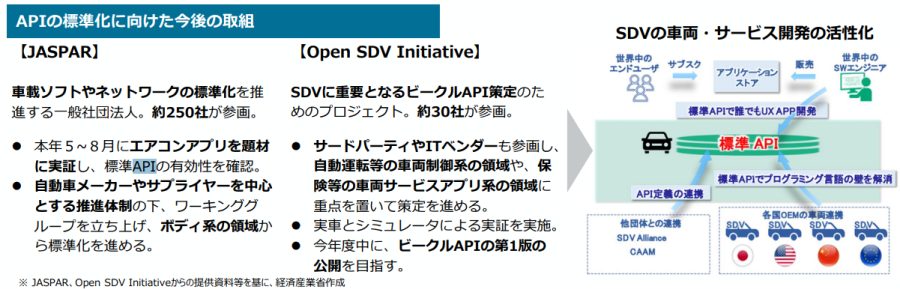
The Ministry of Economy, Trade and Industry’s Mobility DX Strategy, which targets a 30% global SDV market share for Japanese automakers, also sees API standards as an important element. The two main domestic organizations taking on this work are JASPAR (Japan Automotive Software Platform and Architecture), established in September 2004 for the standardization and commonization of in-vehicle software, networks, and related technologies and now involving about 250 companies centered on the automotive industry, including Toyota Motor Corporation, Honda Motor Co., Ltd., and Nissan Motor Corporation; and the Open SDV Initiative (hereafter OSDVI), a project involving around 60 companies, including IT firms, to formulate APIs for SDVs.
JASPAR has a number of working groups that discuss standardization, and in February 2025 an API Technology Working Group was added. It is primarily responsible for the “body domain,” which covers basic vehicle functions such as components, driving, abnormal behavior, and air-conditioning control, with the aim of realizing SDVs whose development costs can be held down and whose functions can be continuously enhanced. OSDVI, launched at the call of Nagoya University, is advancing API formulation with a focus on enabling third parties to develop and provide applications. Its goal is to create new services and value that integrate people’s daily lives with automobiles—in other words, value that goes beyond mobility alone—and third-party participation is seen as important for improving development efficiency. The Mobility DX Strategy states that “the usefulness of the standard specifications formulated by each organization will be verified,” setting out a policy of raising the level of SDV development in Japan through joint efforts by industry, government, and academia.
Results in the Air-Conditioning Domain: From “Competition” to “Collaboration” in the Auto Industry
How, then, are the automotive industry and related sectors working together toward API standards? Junsuke Ino, Chair of the JASPAR Steering Committee and Expert Leader in Nissan Motor’s Software Development Department, explains: “SDV development requires a sense of speed across a wide range of fields, including communications, security, safety, and the APIs related to them, and companies already recognize that it is difficult to tackle all of this independently. At the same time, the track record of JASPAR’s various working groups in their respective technical areas has begun to come together, and momentum is growing more than ever to move beyond ‘competition’ toward ‘collaboration.’” In other words, while companies are still competing today, they are also moving to identify areas likely to become broadly general-purpose in the future and to collaborate on those.

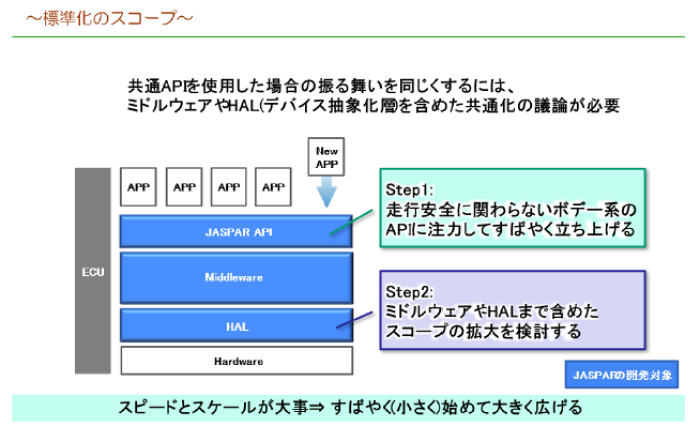
The API working group is conducting proof-of-concept experiments aimed at standardization, centered on the lead companies. Some results have already been achieved. In the air-conditioning domain, the group created an application close to a finished product that could be shared by three companies. Nissan verified it on a bench simulator, while Toyota and Honda tested it on their own vehicles, confirming operation in a short period of time. Although the way air-conditioning is operated differs from vehicle to vehicle, the basic elements—such as detecting cabin temperature, controlling airflow, and closing windows accordingly—are the same, and the effort was to standardize those parts. Once implemented, each automaker would be able to omit everything from application development to testing for those basic functions, enabling major cost reductions and faster development.
Going forward, the challenge will be how to standardize APIs not only in non-competitive fields such as air-conditioning, but also for controlling hardware related to vehicle safety—functions such as “go,” “turn,” and “stop.” Based on such standardized APIs, OEMs and other automotive-related companies would then customize them using their own expertise, and once APIs related to safety are established, barriers to entry for outside companies with strengths in software would fall. This is expected to lead ultimately to faster SDV development by Japanese automakers and stronger competitiveness. To strengthen its structure, the working group plans to adopt an agile approach, repeating the cycle from design to implementation and testing over short intervals.
Maintaining and Strengthening Competitiveness: “International Standardization” Will Be Key
For Japanese automakers to strengthen their competitiveness in SDVs, it will be important to turn these APIs into international standards. That would increase the likelihood that Japan can take the initiative in the software domain, which lies at the core of SDVs. Mr. Ino says, “First, it is important to standardize domestically. Based on that, we aim for international standardization in coordination with domestic automotive organizations such as JAMA (Japan Automobile Manufacturers Association) and JSAE (Society of Automotive Engineers of Japan).” More specifically, JAMA is responsible for setting overall industry direction; JASPAR for deeper technical work, including APIs; J-Auto-ISAC for cybersecurity; and JSAE for standard-setting. As of March 2026, progress has already been made toward standardization in broad-based frameworks such as ISO (International Organization for Standardization), which covers a wide range of products and services, and AUTOSAR (Automotive Open System Architecture), which specializes in automotive software, including areas such as requirements related to over-the-air wireless communication.
For Japan’s automotive industry to remain a core industry and continue contributing to the Japanese economy, it will be important for OEMs and the broader automotive sector to deepen collaboration with other industries and respond to the speed demanded by the SDV era. Mr. Ino also stresses that “there is an even greater need for a framework in which industry, government, and academia work as one, transcending the boundaries between ministries and between industries.”
Related Articles
-
- # Human Resource Development
- # Mobility DX
2026.03.31
-
- # Human Resource Development
- # Mobility DX
2026.03.05
-
- # Human Resource Development
- # Mobility DX
2026.03.05